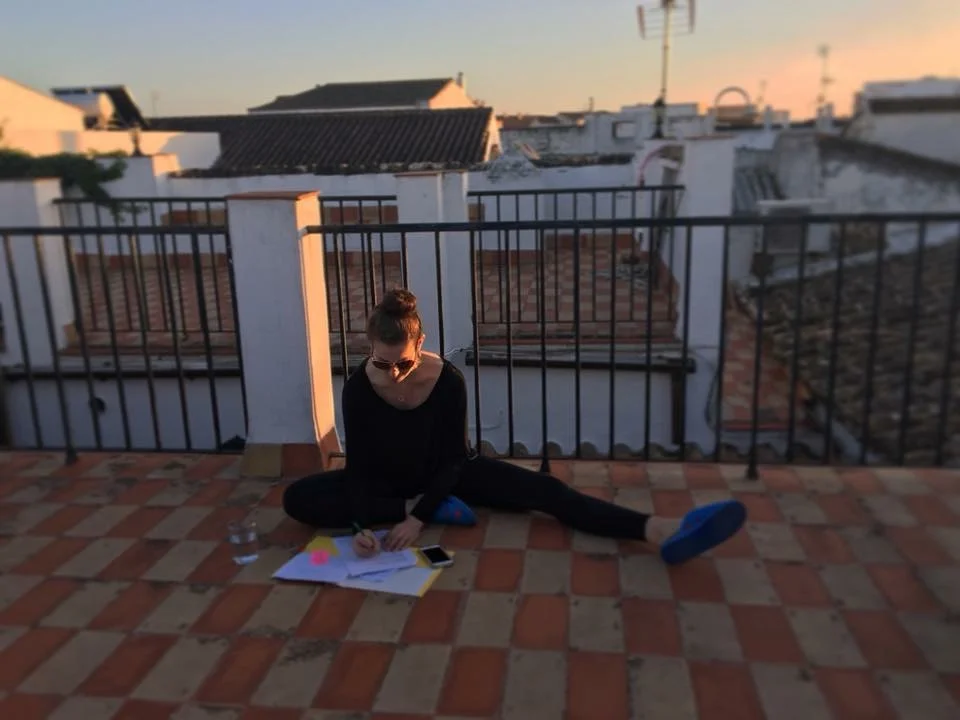
~ ¿Por qué? Muchas razónes... body mind challenge, growth, because I can, because I have to for sanity and so much more ~
"Why?
To connect To challenge To remember To create To shift To celebrate"
"Flamenco
asks me again and again to look inward. Through messing up, experimenting, and figuring out THAT step or THAT turn, I learn new things about myself. It's visceral. AND it's fun!"
"To see
what my body is capable of"
The other night, well actually it was a couple of months ago, I was lying awake in my bed. It was way past my bedtime. And I had this feeling.
This feeling of gratitude.
Agradecimiento.
For technology for allowing me to lie in my bed in Portland, Oregon and watch bulerías in Spain while keeping compás on the side of the bed.
It happened while I was watching this video of David Palomar.
I was rehearsing with Kuma the other day when I accidentally learned a bunch of lessons. All lessons that I'd learned before, as so often is the case.
He was playing cajón. I was dancing. And not long into things, the re-noticings started coming. One after another. I had to keep running over to my phone to write them down. Because I was so excited. And because I didn't want to forget.
After awhile, on account of one of the noticings, I realized it was time to stop running away from our practice to write them down.
This was important.
Today one of my favorite videos of Rocío Molina dancing tangos and some thoughts on the importance of watching flamenco dance.
Watching is a must. We talk a lot about listening, which is importantísimo. Absolutely essential.
But so is watching.
We are lucky. We have YouTube. We have Vimeo. We have Did Somebody Say Flamenco?
We have access to all kinds of good flamenco.
In our kitchens. In our bedrooms. In our offices. (Don't worry I won't tell.)
So watch.
It's pleasure.
It's study.
It's inspiration.
It's necessary.
I know you do this. And in a minute I want to hear about a favorite video of yours.
oday in bulerías at Los Cernícalos I heard Junquerita sing this letra, along with this one, and a bunch of others. Because he sings and sings and sings and sings as people dance and dance and dance and dance. It is great.
Then Ani wanted to teach everyone some new moves. She talked about how changing your bulerías moves is kind of like changing your clothes. You might put on a different shirt one day but wear the same skirt from the previous day. Or perhaps you'll change both. It just depends.
The point is you choose.
Keep Reading
It's the final installment of the interview series with Perico Navarro. Today he shares some advice for all students, talks about what inspires him, talks about the role of cajón in Jerez, and tells us how he feels about audiences in Jerez and beyond. You'll also see a video with Mercedes Ruíz dancing to Paco Cepero's guitar with Pedro accompanying.
Inspiration
¿Qué te inspira? Yo como percusionista flamenco siempre voy acompañando algún artista.
It's more from the interview with Perico Navarro. You can catch the previous segment here.
Today's interview, I have to warn you, gets a bit technical. But just keep reading, I think you'll be glad you did. Pedro talks about outside influences, playing with incredible artists - You'll see an great video of him playing with El Torta and Jesús Méndez in Jerez - and the beginning of his career with Mercedes Ruíz and Santiago Lara.
Ok, so here's the part two to yesterday's post that I promised you. Where I tell you how to turn any class into an ideal class for you. Because sometimes class feels too easy. And other times it feels too hard.
I've been in both situations.
And here's what I've discovered
When class feels too easy, it's usually because I've got my lazy pants on. No seas floja, Laura.
When class feels too difficult, it's usually because hard-on-myself me has taken over. Tranquila, chiquilla.
We can get a lot or a little out of class
And it's really up to us. I mean it.
Basically there are two main concepts we need to understand, one to make class harder and another to make it easier. But before we get to those, some specific ideas on how to make the most out of whatever class you find yourself in.
Not really. It may be called Beginning. Or Advanced.
And that name might tell me about the pace of the class. Or about the type or amount of information and material that will be given.
But what does it really mean?
Is what I view as beginning the same as what you view as beginning?
Can I expect to find people all at the same skill level because the class is called intermediate?
Does the name of the class tell me where I belong?
No and not necessarily.
I have some thoughts on figuring out which class you "belong" in and some more thoughts about what to do should you find yourself in a class that feels like the wrong level.
Another story from Jerez...
Somehow I convinced everyone to go to bulerías class with me
I told them how it terrified me. I told them I was terrorized by it. But they still wanted to go.
I took them there even before our first class with Mercedes.
I needed for them to see it. I was hoping they would want to take it too. I was worried they might think it was too much on top everything else.
Physically it is not demanding. So, that would be no issue.
But mentally, well...
I had told them about it the night before
They were ready for certain things.
You've heard me talk about Ani and her bulerías class and about bits of wisdom I've learned from her. I want to share another bit today.
It's one of those things she said that sent me scurrying to my notebook. I didn't think much about it when she said it. I just knew it was importante and that I wanted to write it down.
Concepts
In bulerías class you learn steps.
But you don't have to do them.
You can. Or you can do your own. Or someone else’s.
So, yes, you learn steps.
But you're really there to learn concepts.
I wrote and posted this story about two years ago. I was so inspired by Akiko that I wanted to repost it today, with a few adjustments. Today when I am feeling overwhelmed and stressed out about all kinds of things.
Today when I am feeling shut down and scared to perform this weekend, as I so often get.
Today when I need grounding and inspiration.
Today I need to remember Akiko in the springtime in Sanlúcar...
Allow me to tell you a bit about Akiko, one of the many inspiring people I've met during my time here in Jerez.
Not too long ago Akiko began taking classes in Japan from Harumi, an incredibly graceful flamenco dancer from Osaka who básicamente seems to have mastered las bulerías de Jerez. She even co-teaches with Ana María López at la Peña los Cernícalos when she is in town.
But back to Akiko.
A video interview with Ricardo López to calm your nerves...
Sometimes we joke around in class about Ricardo
Not behind his back, don't worry. We do it both when he's here and when he's not. We pretend we're him, and we walk around with intense looks on our faces, vigilando.
Other times we just pretend he's there in the room with us, looking like he looks.
It's fun. You should try it.
The thing is, he doesn't usually have an intense look on his face
In the video below, you can see for yourself.
I ask him about getting nervous before a workshop. Because the thought of studying with an out-of-this-world amazing dancer from Spain who is used to dancing with the best of the best can feel a little bit intimidating to some of us around here.
You can’t do flamenco and not do jaleos. You just can’t. It can feel awkward at first, I know. No te preocupes. I have some ideas on how to become more comfortable with this whole jaleos thing.
First, a few and how to pronounce them:
como es eso [coh-moh eh eh-so]
vamos allá [vah-moh ah-yah]
que toma toma toma toma toma [kay toh-mah...]
Here is a list of some common (& simpler) ones, along with some embarrassing admissions of accidentally giving them in English. Oops.
I used to be afraid to give jaleos
I thought I would sound stupid. I thought people would laugh at me. But mostly, it just felt so unnatural.
But not anymore.
It was November 2012, and I was in Jerez. My exotic pets had all gone home, except for one that is. And I kept getting messages, important messages... November 7, 2012
I started getting them about a week ago, the messages. Or that's when I started hearing them.
They were sent on various occasions.
But always during class.
And they were all more or less the same.
Occasion #1 | Monday morning at the peña
Things changed in bulerías this week.
Keep Reading
Today's letra has me dreaming. I wish it had occurred to me a couple of weeks ago while in San Diego when Margot asked to learn a new song. Because this one feels just right for my sobrinas.
I want what it speaks of.
Un puente. Yes, a bridge. And I would make it a magic bridge. A bridge that could take us over a thousand miles in mere minutes. Oh the visits we would have!
Anyway, we can sing it together next time.
For today, I share it with you.
The other day I made a great discovery. (I'll tell you about it in a minute.) But first I want to talk about noticing, something I did a lot of last year. It helps me to focus. It teaches me all kinds of things. And I intend to keep it up.
At times I record the noticings in little books. At times I share them with others, like you. At times they just stay in my cabeza. Other times in my cuerpo.
Noticing is good.
It shows me stuff. Like tendencies to rush, to stop listening, to leave my body.
It tells me what I need to work on.
It points out when I’m enjoying myself and when I’m not, to what factors into that, and how certain things feel.
It teaches me about how I like to create, about environments I work best in, about how I like to dance, why I like to dance, and who I like to dance with.
Keep Reading
Another story from Jerez...
Getting in
One day in bulerías class Ani asked me to tell the ladies that getting in is the hardest part.
And so I did.
I told you I'd tell you about green bananas. And so, a short story from Jerez. A story including yet another tip.
Tú vas a comer un plátano verde?
This is what Ani asked Ana.
Ani is Ana María López, the bulerías teacher.
Ana is a student from Russia.
Un plátano verde is a green banana.
You don’t eat a green banana.
That's what Ani told her.
Last Saturday was the holiday fiesta. And we did bulerías. In our way.Which reminds me....
I told you I'd be giving you more little tips from Ani's class.
But first let's talk briefly about steps
Because you learn a lot of steps in in bulerías class.
You could say they are just steps.
To play with.
To practice.
To try out.
To hold on to. (If you like.)
They can even be thought of as tools for understanding how the conversation works.